
The Curious Incident of the Dog in the Night-Time is a first-person narrative game about a boy with Asperger syndrome adapted from the novel of the same name.
The player character is a special kid with Asperger's who doesn't know how to get along with people. People like him are considered disabled men in China, while I think he only differs from the majority. I want to build their social image through the game.

Why doing this?
MY FIRST EXPERIENCE WITH ASPERGER'S
I followed my professor to a school in Beijing that provides education and rehabilitation for children of special groups last spring. It started as an illustration for their textbook and was the first time I got to know them.
I learned from the parents and teachers that people with Asperger's face many social problems. I want to show a story about their heavy but brave through the game.

Key Features
- Difficulties in social interaction and nonverbal communication
- Restricted and repetitive patterns of behaviour and interests
- Excessive sensitivity or hyposensitivity to environmental stimuli, etc
I went Online to find more information about Asperger's. There are some posts on chinese communication platform.

INSPIRATIONS
These works bring out flesh-and-blood characters from touching stories rather than cold and rigid terms in medical instructions. It helps the public look at the matter as equivalence instead of discrimination or compassion.


To the Moon Mary & Max Rain Man Aspergirls The Curious Incident of the Dog in the Night-Time
Game Cartoon Film Autobiography Fiction Play
Game Design
NARRATIVE
The story begins with a murdered puppy. Christopher(PC) decides to investigate the death independently and writes it into a book. He knocks on every neighbor's door persistently to investigate though he hates getting along with people. During the process, Christopher realizes that his mother, who should have passed away two years ago, is still alive. Therefore, he steps out of the familiar world to look for her.
Discovery of the dog's death
Look for the Murderer bying inquier neighours
Find out the truth of dog's and mother's death
A trip for mother
Ending
CHARACTERS
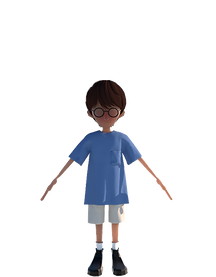
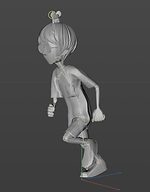
I adopt a low-poly style in character design. The character's face is de-emotised, showing is difficult for Christopher to understand facial expressions.
I referenced the image of a boy with Asperger's from a documentary when I created Christopher.





INTERCATION
The operation depends on the action to be completed in the scenario.
Press keys Click Move around Drag
DIEGETIC UI
They are positioned at the needed focal point as visual guidance.


SCENES
! The following parts contain more than one short video.
Discovery of the dog's death
Christopher discovered his neighbor Mrs. Shears' dog dead in the garden. He is mistaken for the murderer, and the cop asks too many questions forChristopher's brain to process.
Move around with WSAD, interacts, and turn the camera by moving the mouse.
When approaching the protagonist, it automatically switches to the first-person angle of Christopher. Then, players can pull out the fork.
It’s an exaggerated first-person low-angle and focal effect. Players can turn the camera by moving the mouse. The followingsection will trigger when the view switches to the cop.
It’s an exaggerated first-person low-angle and focal effect. Players can turn the camera by moving the mouse. The followingsection will trigger when the view switches to the cop.
Christopher persistently knocked on one neighbor's door after another despite his aversion to human contact, however, this rather highlighted his courage.
Look for the Murderer bying inquier neighours


Control the character to raise the arm and knock on the door by moving the mouse upwards. It forces failure for the first two times and triggers the animated monologue. It shows the protagonists' resistance to socializing with strangers and their courage and determination. And by seeing the character's hands and reflection through the glass, players have an enhanced immersive experience in this first-person game.
Click on the diary to choose which neighbor to inquire with.
When Christopher talks to the neighbor, players can control the camera by moving the mouse around. Initially, the NPC's (neighbor's) face is out of the frame, depicting Christopher's unwillingness to look at the stranger's eyes when talking.
Subtitles are placed at the top of the frame, directing players to drag the camera up. Also, it is more difficult to move upwards here, and the field of vision quickly bounces back once let loose. It takes effort to see the NPC's face. Discomfort brought by such interaction expresses the protagonist's resistance to looking at a stranger's face.

Christopher finds out his mother is still alive by reading a letter. His father seeks forgiveness after lying to him.
The abstract expressions, raining in the room andflooding Christopher, show his feelings of insecurity and suffocation. Father is in a boat right after the scene where Christopher is in the water.
Find out the truth of dog's and mother's death
Interact with objects by moving the mouse to illuminate a limited field of view. In the beginning, players need to find the letter. When reading the text, different content can trigger various animated monologues. When finishing up on reading, animated plot plays.


Players need press W fast and hard to move toward his father, indicating that the protagonist can't understand white lies and can't get closer to his father. This gesture of the father is derived from the novel.

Test
I asked friends with Asperger's to evaluate the program to ensure it was correct. One of them, Zhang, gave me a lot of feedback and advice on testing.
She mentioned that, first of all, she did feel confused when there were too many questions at the same time, that she could not process multiple contents simultaneously and that she could only process them in order. She described her brain as having a DOS system installed and mine as having a WINDOWS system installed. So in the scenario of the police asking questions, she thought that the feeling presented in my project was similar, but the "Blue Screen of Death" of her brain feeling might be more obvious if several people were asking her questions simultaneously.
Second, she did feel uncomfortable looking into the eyes of others when interacting with them. She mentioned that besides letting her eyes move around, staring at a specific place, like the other person's tie, was also something she would do. Also, regarding the example of sensory overload in the subway station scene, Zhang said that for her, noise, light, and some fluorescent colors make her feel uncomfortable. Things are not as exaggerated as in my video, but the scenes she describes need to be quantified to make Neurotypical people feel uncomfortable, so how this experimental scene should continue to be refined is open to discussion. Zhang also mentioned that she would wear sunglasses and earplugs to reduce the effects of excessive light and noise and that some movements would have a soothing effect, which she thought should be added.
Finally, Zhang mentioned in the character design section that she couldn't directly recognize other people's expressions. Still, she can identify some simple expressions by memorizing features, but she can't understand why I remove characters' facial features. However, another person among the test subjects said that he would have some facial blindness sometimes, and he could get it what I do.
In summary, Zhang and others' suggestions were very constructive, and I will further improve this project afterward.